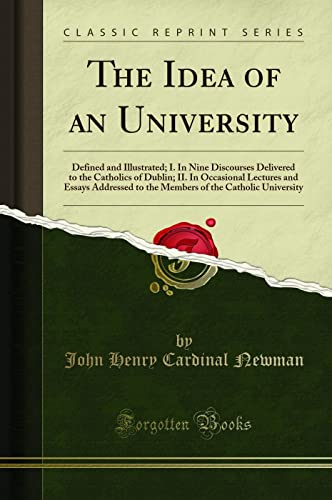
University in these Discourses is the following: That it is a place of teaching universal knowledge. This implies that its object is, on the one hand, intellectual, not moral; and, on the other, that it is the diffusion and extension of knowledge rather than the advancement If its object were scientific and philosophical discovery, I do not see why a University should have students ;if religious training, I do not see how it can be the seat of literature and science. Such is a University in its essence, and independently of its relation to the Church. But, practically speaking, it cannot fulfil its object duly, such as I have described it, without the Church sassistance; or, to use the theological term, the Church is necessary for its integrity. Not that its main characters are changed by this incorporation :it still has the office of intellectual education ;but the Church steadies it in the performance of that office. Such are the main principles of the Discourses which follow; though it would be unreasonable for me to expect that I have treated so large and important a field of thought with the fulness and precision necessary to secure me from incidental misconceptions of my meaning on the part of the reader.
(Typographical errors above are due to OCR software and don't occur in the book.)
About the Publisher
Forgotten Books is a publisher of historical writings, such as: Philosophy, Classics, Science, Religion, History, Folklore and Mythology.
Forgotten Books' Classic Reprint Series utilizes the latest technology to regenerate facsimiles of historically important writings. Careful attention has been made to accurately preserve the original format of each page whilst digitally enhancing the aged text. Read books online for free at www.forgottenbooks.org