| Search | About | Preferences | Interact | Help | |
| 150 million books. 1 search engine. | ||

› Find signed collectible books: 'The Dawn's Early Light'

› Find signed collectible books: 'Day of Infamy'

More editions of Day of Infamy:

› Find signed collectible books: 'Incredible Victory'
More editions of Incredible Victory:

› Find signed collectible books: 'Lonely Vigil: Coastwatchers of the Solomons'
More editions of Lonely Vigil: Coastwatchers of the Solomons:

› Find signed collectible books: 'The Miracle of Dunkirk'
On May 24, 1940, Hitler s armies were on the brink of a shattering military victory. Only ten miles away, 400,000 Allied troops were pinned against the coast of Dunkirk. But just eleven days later, by June 4, 338,000 men had been successfully evacuated to England. How did it happen? Walter Lord s remarkable account of how the miracle of Dunkirk came about is based on hundreds of interviews with survivors of all nations who fought among the sand dunes of northern France. [via]

› Find signed collectible books: 'Night Lives On'
More editions of Night Lives on:
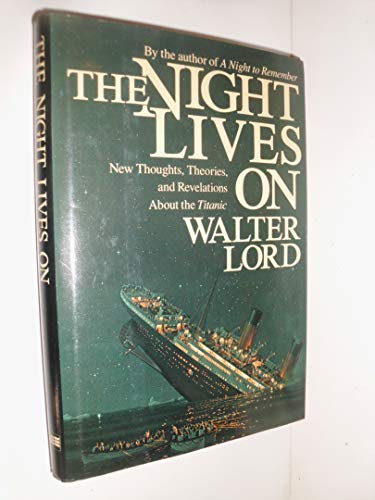
› Find signed collectible books: 'The Night Lives On : The Untold Stories and Secrets Behind the Sinking of the "Unsinkable" Ship - Titanic!'
You might say that Walter Lord provoked the whole Titanic mania by interviewing dozens of survivors and fashioning their reminiscences into the classic non-fiction novel A Night to Remember, which was made into a 1958 film that heavily influenced James Cameron's 1998 epic. Some of the dialogue is more vivid than the 1998 film--when a kid sees the deadly iceberg, he says excitedly, "Oh, Muddie, look at the beautiful North Pole with no Santa Claus on it."
But much has been discovered since Lord's original book made waves--such as the shipwreck itself, and a wealth of scientific inquiry. So he wrote this semisequel, which tackles each of the remaining mysteries about the unnecessary calamity in a methodical, but quite readable, fashion. How come the wireless operators blew it so fatally? Maybe they would have had better operators if they paid them more than $5 a week--as Lord notes, it would have taken a wireless operator 18 years to earn one transatlantic ticket. How come the Californian just sat there in nearby waters and neglected to save anyone on the frantically signaling and flare-firing Titanic? Lord quotes a man on the nonsinking ship admitting to "a certain amount of slackness," which he uses for a sardonic chapter title.
Some of the characters are more sympathetic, such as Renee Harris, who used the money she won suing the Titanic owners for her husband's death to bankroll neophyte playwright Moss Hart's first show. Lord says that Hart's memoir, Act One, depicts Harris reacting to an opening-night flop with optimism. After you've survived the Titanic, what's to worry?
Walter Lord has gotten better reviews, and he needn't fret about his reputation. The Pulitzer Prize-winning historian Barbara Tuchman, author of A Distant Mirror, had this reaction to Night Lives On: "Stunning ... his detection and discoveries make a first-class historical reconstruction and a model in the research and writing of that difficult art." --Tim Appelo [via]
More editions of The Night Lives On: The Untold Stories and Secrets Behind the Sinking of the "Unsinkable" Ship - Titanic!:
› Find signed collectible books: 'Night to Remember'
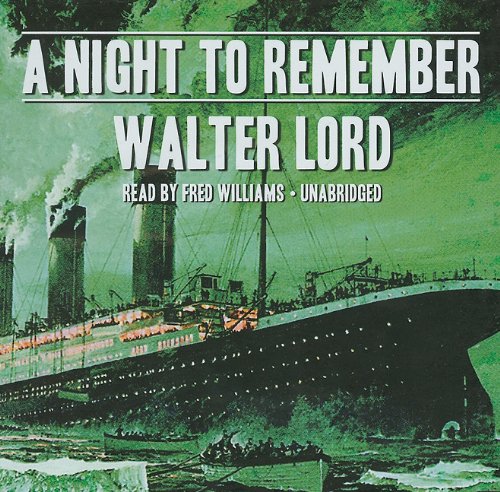
James Cameron's 1997 Titanic movie is a smash hit, but Walter Lord's 1955 classic remains in some ways unsurpassed. Lord interviewed scores of Titanic passengers, fashioning a gripping you-are-there account of the ship's sinking that you can read in half the time it takes to see the film. The book boasts many perfect movie moments not found in Cameron's film. When the ship hits the berg, passengers see "tiny splinters of ice in the air, fine as dust, that give off myriads of bright colors whenever caught in the glow of the deck lights." Survivors saw dawn reflected off other icebergs in a rainbow of shades, depending on their angle toward the sun: pink, mauve, white, deep blue--a landscape so eerie, a little boy tells his mom, "Oh, Muddie, look at the beautiful North Pole with no Santa Claus on it."
A Titanic funnel falls, almost hitting a lifeboat--and consequently washing it 30 yards away from the wreck, saving all lives aboard. One man calmly rides the vertical boat down as it sinks, steps into the sea, and doesn't even get his head wet while waiting to be successfully rescued. On one side of the boat, almost no males are permitted in the lifeboats; on the other, even a male Pekingese dog gets a seat. Lord includes a crucial, tragically ironic drama Cameron couldn't fit into the film: the failure of the nearby ship Californian to save all those aboard the sinking vessel because distress lights were misread as random flickering and the telegraph was an early wind-up model that no one wound.
Lord's account is also smarter about the horrifying class structure of the disaster, which Cameron reduces to hollow Hollywood formula. No children died in the First and Second Class decks; 53 out of 76 children in steerage died. According to the press, which regarded the lower-class passengers as a small loss to society, "The night was a magnificent confirmation of women and children first, yet somehow the loss rate was higher for Third Class children than First Class men." As the ship sank, writes Lord, "the poop deck, normally Third Class space ... was suddenly becoming attractive to all kinds of people." Lord's logic is as cold as the Atlantic, and his bitter wit is quite dry. [via]
More editions of A Night to Remember:

› Find signed collectible books: 'The Past That Would Not Die.'
More editions of The Past That Would Not Die.:

› Find signed collectible books: 'A Time to Stand'
More editions of A Time to Stand:
Founded in 1997, BookFinder.com has become a leading book price comparison site:
Find and compare hundreds of millions of new books, used books, rare books and out of print books from over 100,000 booksellers and 60+ websites worldwide.