| Search | About | Preferences | Interact | Help | |
| 150 million books. 1 search engine. | ||

› Find signed collectible books: 'The Changing Face of America'
More editions of The Changing Face of America:

› Find signed collectible books: 'First and Last'
More editions of First and Last:
› Find signed collectible books: 'Let Us Now Praise Famous Men'
Just what kind of book is Let Us Now Praise Famous Men? It contains many things: poems; confessional reveries; disquisitions on the proper way to listen to Beethoven; snippets of dialogue, both real and imagined; a lengthy response to a survey from the Partisan Review; exhaustive catalogs of furniture, clothing, objects, and smells. And then there are Walker Evans's famously stark portraits of depression-era sharecroppers--photographs that both stand apart from and reinforce James Agee's words.
Assigned to do a story for Fortune magazine about sharecroppers in the Deep South, Agee and Evans spent four weeks living with a poor white tenant family, winning the Burroughs's trust and immersing themselves in a sharecropper's daily existence. Given a first draft of the resulting article, the editors at Fortune quite understandably threw up their hands--as did several other editors who subsequently worked with a later book-length manuscript. The writing was contrary. It refused to accommodate itself to the reader, and at times it positively bristled with hostility. (What other book could take Marx as the epigraph and then announce: "These words are quoted here to mislead those who will be misled by them"?) Response to the book was puzzled or unfriendly, and Let Us Now Praise Famous Men sputtered out of print only a few short years after its publication. It took the 1960s, and a vogue for social justice, to bring Agee's masterwork the audience it deserved.
Yet the book is far more interesting--aesthetically and morally--than the sort of guilty-liberal tract for which it is often mistaken. On an existential level, Agee's text is a deeply felt examination of what it means to suffer, to struggle to live in spite of suffering. On a personal level, it is the painful, beautifully written portrait of one man's obsession. In its collaboration with Evans's photographs, the book is also a groundbreaking experiment in form. In the end, however, it is more than merely the sum of its parts. Let Us Now Praise Famous Men is, quite simply, a book unlike any other, simmering with anger and beauty and mystery. --Mary Park [via]
More editions of Let Us Now Praise Famous Men:
› Find signed collectible books: 'Let Us Now Praise Famous Men: 3 Tenant Families'
Just what kind of book is Let Us Now Praise Famous Men? It contains many things: poems; confessional reveries; disquisitions on the proper way to listen to Beethoven; snippets of dialogue, both real and imagined; a lengthy response to a survey from the Partisan Review; exhaustive catalogs of furniture, clothing, objects, and smells. And then there are Walker Evans's famously stark portraits of depression-era sharecroppers--photographs that both stand apart from and reinforce James Agee's words.
Assigned to do a story for Fortune magazine about sharecroppers in the Deep South, Agee and Evans spent four weeks living with a poor white tenant family, winning the Burroughs's trust and immersing themselves in a sharecropper's daily existence. Given a first draft of the resulting article, the editors at Fortune quite understandably threw up their hands--as did several other editors who subsequently worked with a later book-length manuscript. The writing was contrary. It refused to accommodate itself to the reader, and at times it positively bristled with hostility. (What other book could take Marx as the epigraph and then announce: "These words are quoted here to mislead those who will be misled by them"?) Response to the book was puzzled or unfriendly, and Let Us Now Praise Famous Men sputtered out of print only a few short years after its publication. It took the 1960s, and a vogue for social justice, to bring Agee's masterwork the audience it deserved.
Yet the book is far more interesting--aesthetically and morally--than the sort of guilty-liberal tract for which it is often mistaken. On an existential level, Agee's text is a deeply felt examination of what it means to suffer, to struggle to live in spite of suffering. On a personal level, it is the painful, beautifully written portrait of one man's obsession. In its collaboration with Evans's photographs, the book is also a groundbreaking experiment in form. In the end, however, it is more than merely the sum of its parts. Let Us Now Praise Famous Men is, quite simply, a book unlike any other, simmering with anger and beauty and mystery. --Mary Park [via]
More editions of Let Us Now Praise Famous Men: 3 Tenant Families:
› Find signed collectible books: 'Many Are Called'
Between 1936 and 1941 Walker Evans and James Agee collaborated on one of the most provocative books in American literature, Let Us Now Praise Famous Men (1941). While at work on this book, the two also conceived another less well-known but equally important book project entitled Many Are Called. This three-year photographic study of subway passengers made with a hidden camera was first published in 1966, with an introduction written by Agee in 1940. Long out of print, Many Are Called is now being reissued with a new foreword and afterword and with exquisitely reproduced images from newly prepared digital scans.
Many Are Called came to fruition at a slow pace. In 1938, Walker Evans began surreptitiously photographing people on the New York City subway. With his camera hidden in his coat—the lens peeking through a buttonhole—he captured the faces of riders hurtling through the dark tunnels, wrapped in their own private thoughts. By 1940-41, Evans had made over six hundred photographs and had begun to edit the series. The book remained unpublished until 1966 when The Museum of Modern Art mounted an exhibition of Evanss subway portraits.
This beautiful new edition—published in the centenary year of the NYC subway—is an essential book for all admirers of Evanss unparalleled photographs, Agees elegant prose, and the great City of New York.
More editions of Many Are Called:
› Find signed collectible books: 'Something Permanent'
More editions of Something Permanent:

› Find signed collectible books: 'Walker Evans, First and Last'
Walker Evans's haunting images of southern sharecroppers in Let Us Now Praise Famous Men were as revolutionary in their time as James Agee's text and are now deeply ingrained in the American consciousness. In the first full biography of this intriguing and enigmatic artist, a leading national authority on Evans looks beyond the calculated anonymity of his work to reveal the singular obsessions behind it. A man in love with Americana, Evans was a sensualist, a junk collector, a connoisseur, a wit, a perpetual weekend guest. His friendships with Hart Crane, Lincoln Kirstein, and James Agee drew him into the promiscuous New York literary scene in the 1930s, '40s, and '50s, and his fierce independence from contemporaries such as Ansel Adams and Margaret Bourke-White brought him notoriety among photographers. Both charismatic and seductively aloof, Evans had a spy's genius for capturing the telling detail. From his rise to prominence with the founding of the Museum of Modern Art to his work [via]

› Find signed collectible books: 'Walker Evans'
More editions of Walker Evans:

› Find signed collectible books: 'Walker Evans at Work'
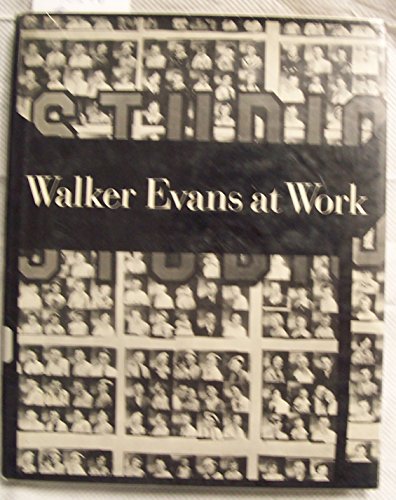
› Find signed collectible books: 'Walker Evans at Work: 745 Photographs Together with Documents Selected from Letters, Memoranda, Interviews, Notes'
More editions of Walker Evans at Work: 745 Photographs Together with Documents Selected from Letters, Memoranda, Interviews, Notes:
› Find signed collectible books: 'Walker Evans: Photographs for the Farm Security Administration, 1935-1938 A Catalog of Photographic Prints Available from the Farm Security Admini'
It's a well-kept secret that the Library of Congress oversees a collection of photographs numbering in excess of three million, the bulk of which are in the public domain. Among the highlights of that collection are Evans' remarkable images of the Depression era--part of a larger photographic project that employed Dorothea Lange and others--documenting the effects of soil erosion in Mississippi, the plight of Arkansas flood victims and the day-to-day lives of Alabama sharecroppers. The mood of the period is evoked strongly by nearly 500 photographs, many reproduced here for the first time; others are memorable for their inclusion in Let Us Now Praise Famous Men. [via]
More editions of Walker Evans: Photographs for the Farm Security Administration, 1935-1938 A Catalog of Photographic Prints Available from the Farm Security Admini:
› Find signed collectible books: 'The Years of Bitterness and Pride: Farm Security Administration, FSA Photographs, 1935-1943'
More editions of The Years of Bitterness and Pride: Farm Security Administration, FSA Photographs, 1935-1943:
Founded in 1997, BookFinder.com has become a leading book price comparison site:
Find and compare hundreds of millions of new books, used books, rare books and out of print books from over 100,000 booksellers and 60+ websites worldwide.