| Search | About | Preferences | Interact | Help | |
| 150 million books. 1 search engine. | ||
› Find signed collectible books: 'Aglow in the Dark: The Revolutionary Science of Biofluorescence'
In the early 1960s, in a small shack on the Washington coast, a young, self-educated Japanese scientist performed an experiment to determine what made a certain jellyfish glow. The substance he discovered, green fluorescent protein, would revolutionize molecular biology, transforming our study of everything from the AIDS virus to the workings of the brain. Aglow in the Dark follows the path that took this glowing compound from its inauspicious arrival on the scientific scene to its present-day eminence as one of the most groundbreaking discoveries of the twentieth century.
The story unfolds in far-flung places, from the coral reefs of the Pacific Ocean, to the medical schools and marine stations of our leading universities, to a cold war-era research laboratory in Moscow. Traversing the globe and the decades, Aglow in the Dark conveys the human fascination with bioluminescence, or "living light," its little-known application in war, forensic science, and molecular biology, and how it led to the finding of green fluorescent protein. The book reveals a hidden world where light is manipulated by animals and humans and put to remarkable uses--unlocking the secrets of the human brain, conquering dreaded diseases, and perhaps someday linking minds and machines. The authors deftly lead the reader through a complex story at the interface of biology and physics--and into the realm of wonder on the frontiers of scientific endeavor.
[via]More editions of Aglow in the Dark: The Revolutionary Science of Biofluorescence:

› Find signed collectible books: 'Beautiful Mind'
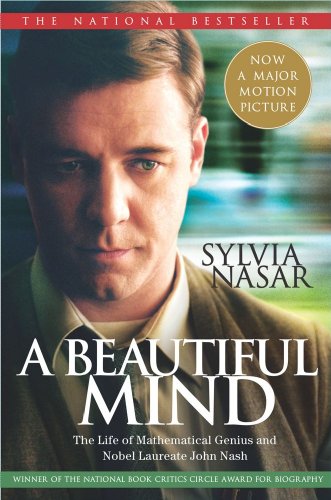
Amazon.com Review: Stories of famously eccentric Princetonians abound--such as that of chemist Hubert Alyea, the model for The Absent-Minded Professor, or Ralph Nader, said to have had his own key to the library as an undergraduate. Or the "Phantom of Fine Hall," a figure many students had seen shuffling around the corridors of the math and physics building wearing purple sneakers and writing numerology treatises on the blackboards. The Phantom was John Nash, one of the most brilliant mathematicians of his generation, who had spiraled into schizophrenia in the 1950s. His most important work had been in game theory, which by the 1980s was underpinning a large part of economics. When the Nobel Prize committee began debating a prize for game theory, Nash's name inevitably came up--only to be dismissed, since the prize clearly could not go to a madman. But in 1994 Nash, in remission from schizophrenia, shared the Nobel Prize in economics for work done some 45 years previously. Economist and journalist Sylvia Nasar has written a biography of Nash that looks at all sides of his life. She gives an intelligent, understandable exposition of his mathematical ideas and a picture of schizophrenia that is evocative but decidedly unromantic. Her story of the machinations behind Nash's Nobel is fascinating and one of very few such accounts available in print (the CIA could learn a thing or two from the Nobel committees). This highly recommended book is indeed "a story about the mystery of the human mind, in three acts: genius, madness, reawakening." --Mary Ellen Curtin [via]
More editions of Beautiful Mind:
› Find signed collectible books: 'A Beautiful Mind: The Life of Mathematical Genius and Nobel Laureate John Nash'
Stories of famously eccentric Princetonians abound--such as that of chemist Hubert Alyea, the model for The Absent-Minded Professor, or Ralph Nader, said to have had his own key to the library as an undergraduate. Or the "Phantom of Fine Hall," a figure many students had seen shuffling around the corridors of the math and physics building wearing purple sneakers and writing numerology treatises on the blackboards. The Phantom was John Nash, one of the most brilliant mathematicians of his generation, who had spiraled into schizophrenia in the 1950s. His most important work had been in game theory, which by the 1980s was underpinning a large part of economics. When the Nobel Prize committee began debating a prize for game theory, Nash's name inevitably came up--only to be dismissed, since the prize clearly could not go to a madman. But in 1994 Nash, in remission from schizophrenia, shared the Nobel Prize in economics for work done some 45 years previously.
Economist and journalist Sylvia Nasar has written a biography of Nash that looks at all sides of his life. She gives an intelligent, understandable exposition of his mathematical ideas and a picture of schizophrenia that is evocative but decidedly unromantic. Her story of the machinations behind Nash's Nobel is fascinating and one of very few such accounts available in print (the CIA could learn a thing or two from the Nobel committees). This highly recommended book is indeed "a story about the mystery of the human mind, in three acts: genius, madness, reawakening." --Mary Ellen Curtin [via]
More editions of A Beautiful Mind: The Life of Mathematical Genius and Nobel Laureate John Nash:

› Find signed collectible books: 'The Best American Science Writing 2008'
More editions of The Best American Science Writing 2008:
› Find signed collectible books: 'Community Mental Health: Challenges for the 21st Century'
Community Mental Health is a significant interdisciplinary resource for students, practitioners, or policy planners, engaged in the evaluation and development of programs in the human services.
Jessica and Sam Rosenberg have carefully pulled together a book containing twenty-two original chapters by leading scholars, consumers, and practitioners in the community mental health field. Together, they offer a wealth of knowledge on the substantial challenges facing contemporary community mental health today.
Packed full with information for both students and practitioners of social work, psychology, sociology, psychiatry, and related disciplines, this comprehensive text includes best practice treatment models for co-occurring disorders, homelessness and mental illness, psychosocial rehabilitation, psychopharmacology, and outpatient treatment. Cutting edge for students and practitioners, this book contains the most up-to-date theory and research about community mental health.
[via]More editions of Community Mental Health: Challenges for the 21st Century:
› Find signed collectible books: 'The Double Helix'
"Science seldom proceeds in the straightforward logical manner imagined by outsiders," writes James Watson in The Double Helix, his account of his codiscovery (along with Francis Crick) of the structure of DNA. Watson and Crick won Nobel Prizes for their work, and their names are memorized by biology students around the world. But as in all of history, the real story behind the deceptively simple outcome was messy, intense, and sometimes truly hilarious. To preserve the "real" story for the world, James Watson attempted to record his first impressions as soon after the events of 1951-1953 as possible, with all their unpleasant realities and "spirit of adventure" intact.
Watson holds nothing back when revealing the petty sniping and backbiting among his colleagues, while acknowledging that he himself was a willing participant in the melodrama. In particular, Watson reveals his mixed feelings about his famous colleague in discovery, Francis Crick, who many thought of as an arrogant man who talked too much, and whose brilliance was appreciated by few. This is the joy of The Double Helix--instead of a chronicle of stainless-steel heroes toiling away in their sparkling labs, Watson's chronicle gives readers an idea of what living science is like, warts and all. The Double Helix is a startling window into the scientific method, full of insight and wit, and packed with the kind of science anecdotes that are told and retold in the halls of universities and laboratories everywhere. It's the stuff of legends. --Therese Littleton [via]
More editions of The Double Helix:
› Find signed collectible books: 'The Essential John Nash'
When John Nash won the Nobel prize in economics in 1994, many people were surprised to learn that he was alive and well. Since then, Sylvia Nasar's celebrated biography A Beautiful Mind, the basis of a new major motion picture, has revealed the man. The Essential John Nash reveals his work--in his own words. This book presents, for the first time, the full range of Nash's diverse contributions not only to game theory, for which he received the Nobel, but to pure mathematics--from Riemannian geometry and partial differential equations--in which he commands even greater acclaim among academics. Included are nine of Nash's most influential papers, most of them written over the decade beginning in 1949.
From 1959 until his astonishing remission three decades later, the man behind the concepts "Nash equilibrium" and "Nash bargaining"--concepts that today pervade not only economics but nuclear strategy and contract talks in major league sports--had lived in the shadow of a condition diagnosed as paranoid schizophrenia. In the introduction to this book, Nasar recounts how Nash had, by the age of thirty, gone from being a wunderkind at Princeton and a rising mathematical star at MIT to the depths of mental illness.
In his preface, Harold Kuhn offers personal insights on his longtime friend and colleague; and in introductions to several of Nash's papers, he provides scholarly context. In an afterword, Nash describes his current work, and he discusses an error in one of his papers. A photo essay chronicles Nash's career from his student days in Princeton to the present. Also included are Nash's Nobel citation and autobiography.
The Essential John Nash makes it plain why one of Nash's colleagues termed his style of intellectual inquiry as "like lightning striking." All those inspired by Nash's dazzling ideas will welcome this unprecedented opportunity to trace these ideas back to the exceptional mind they came from.
[via]More editions of The Essential John Nash:

› Find signed collectible books: 'The Essential John Nash'
More editions of The Essential John Nash:

› Find signed collectible books: 'Grand Pursuit'
More editions of Grand Pursuit:

› Find signed collectible books: 'Una Mente Prodigiosa'

More editions of Una Mente Prodigiosa:

› Find signed collectible books: 'Genie und Wahnsinn.'
More editions of Genie und Wahnsinn.:

› Find signed collectible books: 'Una Ment Meravellosa: Biografia de John Forbes Nash, Premi Nobel D'economia 1994'
More editions of Una Ment Meravellosa: Biografia de John Forbes Nash, Premi Nobel D'economia 1994:
Founded in 1997, BookFinder.com has become a leading book price comparison site:
Find and compare hundreds of millions of new books, used books, rare books and out of print books from over 100,000 booksellers and 60+ websites worldwide.